Here's an animation I made with Flash. For every one trip back and forth that the top circle makes, the second circle makes 2 trips, the third 3 trips, and so on. Try with 2 or 3 objects to see better what's happening, then explore larger numbers (100-300 is nice).
Despite the simplicity of the math, there are lots of crazy patterns that pop up as you watch the strands weave and unweave. There are connections here to factors and primes. Notice how you can catch sight of, for example, 4 strands, then 3, then 5, then 2, then ...? What is happening? What is the pattern?
Friday, September 16, 2011

Thursday, September 15, 2011
Decision Tree
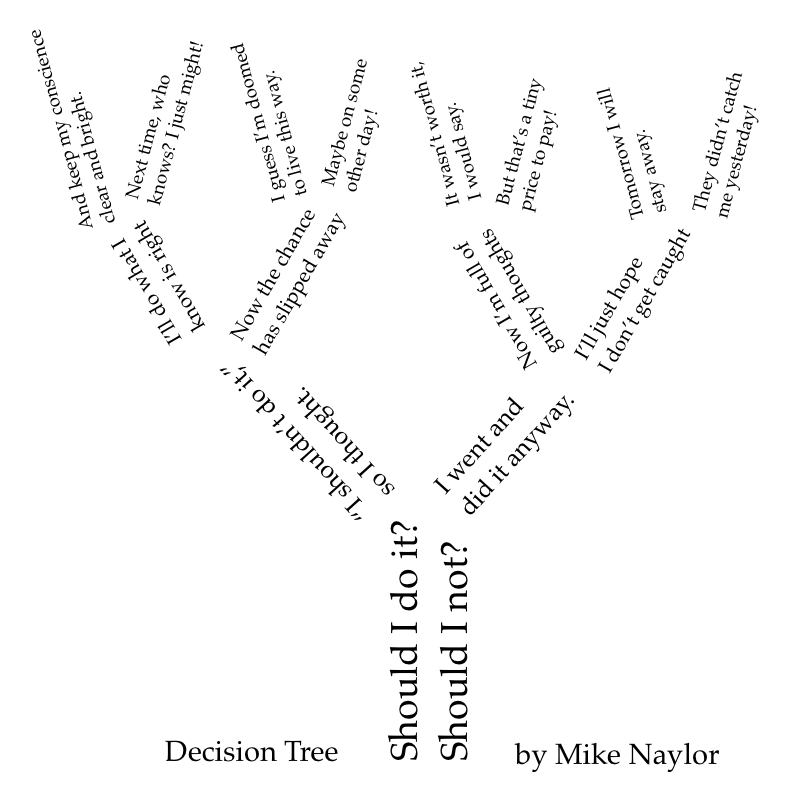
This poem originally appeared in College Math Journal under the title "Tree Diagram". I was asked to reformat it for inclusion into a thematic literacy issue in the journal "Symmetry: Culture and Science". This is the new format: a tree!
There's a structure placed on the poem that creates an unusual result. The first line is the question, the second the decision, the third the reaction, and the fourth the future effect. There is then an angel-devil influence in the directions of the lines; movement to the left is leaning towards the 'good' and towards the right is leaning towards the 'bad'. What I found surprising is that many of the poem sequences in this tree are kind of depressing ("... now the chance has slipped away, I guess I'm doomed to live this way.") but there are two sequences that are special.
In the extreme left and the extreme right sides of the tree you can find two poems where you get the feeling the narrator feels good about his/her choices and is satisfied with the way life is going. While this may not make any flattering statements about morality, I think it does say something about consistency. In life, as in mathematics, we are free to choose which rules we will live by. Once you've done so, you should be consistent with these rules or you run the risk of being dissatisfied.
Can we really learn that from mathematics?
Thursday, September 8, 2011
Artwork in Journal of Mathematics and the Arts
My artwork from the 2010 Bridges conference made its way into the Journal of Mathematics and the Arts (Volume 5, Issue 2, 2011). Here's a link to the article and a screenshot of the page with my artwork. The article has lots of examples of the good mathematical art that is celebrated at this conference.
The mathematical art exhibit at Bridges Pecs Hungary, July 2010

The mathematical art exhibit at Bridges Pecs Hungary, July 2010

Saturday, September 3, 2011
A visit with George Hart
I had the pleasure of visiting renowned polyhedra artist George Hart at his home in Stony Brook, NY this summer. His house is filled with his polyhedral creations -- no surface is left untouched by mathematical beauty in this geometry paradise.
We had a lovely afternoon playing with puzzles and talking math. George took us into his shop and demonstrated a very interesting cut on his scroll saw. By making a single spiral cut as he twisted a dowel down through a blade, he separated the wood into two parts, but not as I expected. The outer piece is hollow, and the inner piece is a wooden screw, like a corkscrew, that can twist in and out of the outer part. All made with one continuous cut. Amazing! Here's a link to a rather amazing explanation and an unbelievable example of four nested spirals made with this method: http://momath.org/home/math-mo


George is an expert geometer, a supportive colleague, and a fascinating and all-around great guy. Check out more of his artwork at www.georgehart.com, and also check his MAJOR project, the Museum of Mathematics at www.momath.org.


We had a lovely afternoon playing with puzzles and talking math. George took us into his shop and demonstrated a very interesting cut on his scroll saw. By making a single spiral cut as he twisted a dowel down through a blade, he separated the wood into two parts, but not as I expected. The outer piece is hollow, and the inner piece is a wooden screw, like a corkscrew, that can twist in and out of the outer part. All made with one continuous cut. Amazing! Here's a link to a rather amazing explanation and an unbelievable example of four nested spirals made with this method: http://momath.org/home/math-mo


George is an expert geometer, a supportive colleague, and a fascinating and all-around great guy. Check out more of his artwork at www.georgehart.com, and also check his MAJOR project, the Museum of Mathematics at www.momath.org.
Wednesday, August 31, 2011
Cube women sculpture
I made my first 3d printing models this summer. I thought it would be as easy as taking my 3d models I use for 2d digital art and converting the files, but in fact I had to rebuild from scratch, with special attention to hair and fingers and making everything perfectly symmetrical. The models then needed to be hollowed out and the walls given thickness. I was holding my breath when the package arrived from the printers – would they snap together as planned? Would they break? It came out perfectly. The figures snap together snugly, the fingers are strong and flexible enough to get a good grip, and the final statue sits flat.
Here's a few shots, with a coffee mug for scale. The sculpture is about 12 cm high.

Here's a few shots, with a coffee mug for scale. The sculpture is about 12 cm high.


You can order a sculpture of your own here if you like!
Saturday, August 13, 2011
The Mike Naylor Trefoil
I had a curve named for me! A big shout out to Will Webber of Bellingham, WA who parameterized one of my favorite shapes to doodle. I used to draw this freehand in my classes, and enjoyed exploring variations with number of loops and number of whorls. None of my sketches ever looked as good as Will's calculated version shown here. Thanks Will!
(Will is a master with parameterizing, you should see him in action as he waves his hands back and forth, gets a feel for the separate x- and y- motions, and then nails the equation. Inspiring!)


(Will is a master with parameterizing, you should see him in action as he waves his hands back and forth, gets a feel for the separate x- and y- motions, and then nails the equation. Inspiring!)


Thursday, March 17, 2011
My favorite palindrome
This took a while to learn to say, but I like to pull this out when palindromes come up in conversation:
A man walks into a bar and says, "Syas dna rab a otni sklaw nam a!"
A man walks into a bar and says, "Syas dna rab a otni sklaw nam a!"
Subscribe to:
Posts (Atom)